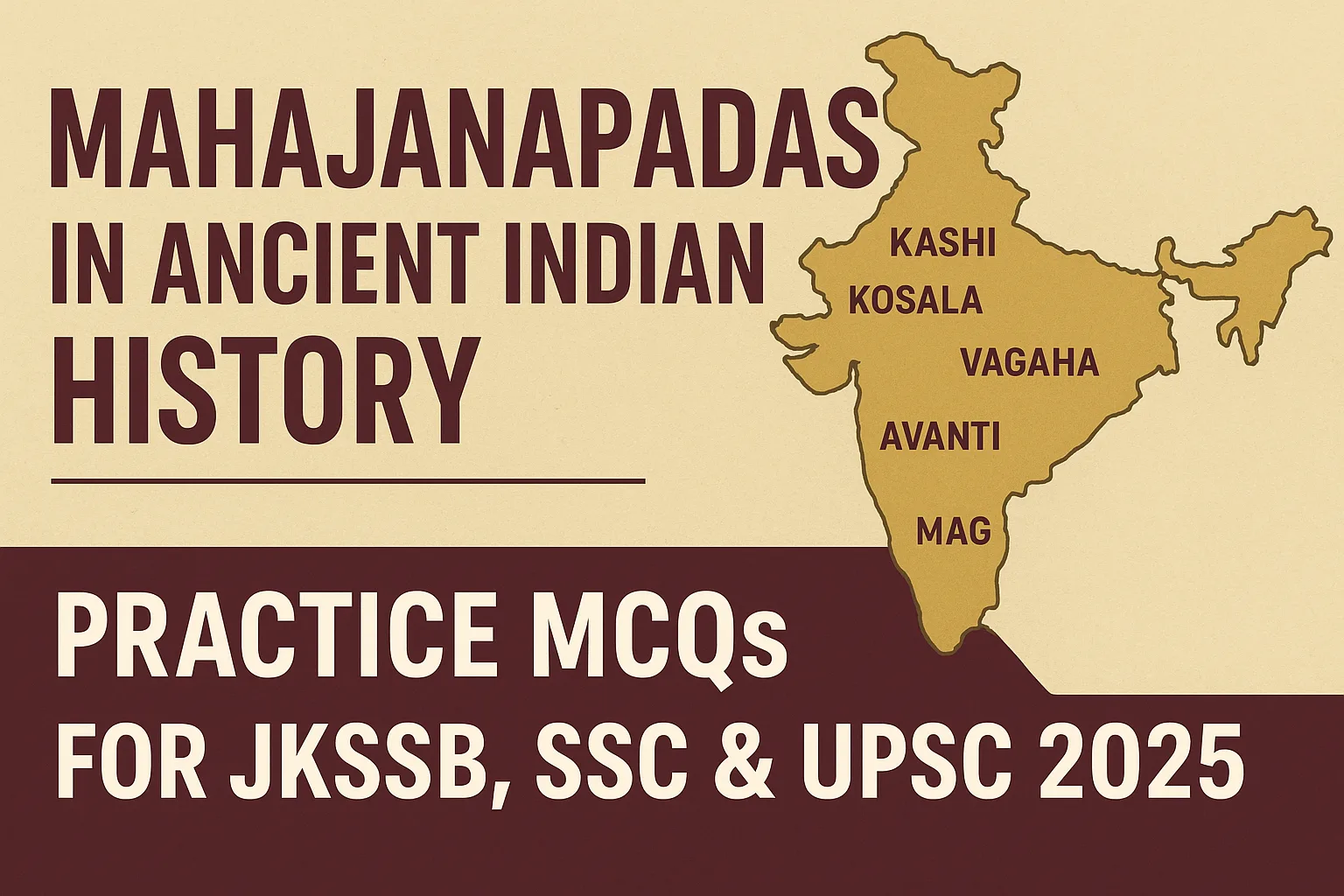
There were 16 Mahajanapadas in total, which emerged in the 6th century BCE. They mark a very important chapter in Indian history. It is also known as the Second Urbanization. This topic is very important from the exam point of view, as every year questions have been asked from it. For all those candidates who are preparing for competitive exams like UPSC, JKPSC, JKSSB, SSC, Railways, and other exams in general, are advised to go through this topic. It not only highlights the economic development but also throws light on the cultural developments of early India. Since this topic is very extensive, it is best to revise by solving MCQs. And for that purpose, our team has researched the most valuable and exam-oriented MCQs for this topic. This is a smart and strategic way to plan this topic. All those candidates who want to save their time and want to utilize it efficiently should go through the below-mentioned MCQs without any second thought to have a quick last-minute revision as well as to secure their chance in the upcoming examination. Solving these MCQs will also help you to analyze your preparation and work accordingly to achieve your goals more efficiently.
-
Around which century BCE did the 16 Mahajanapadas emerge as powerful states in ancient India?
(A) 10th century BCE
(B) 6th century BCE
(C) 2nd century BCE
(D) 12th century BCE
Correct Answer: (B) 6th century BCE -
The 16 Mahajanapadas mainly developed in which geographical regions of the Indian subcontinent?
(A) Indo-Gangetic plains and northern Deccan
(B) Western Ghats and southern India
(C) Kashmir and Ladakh
(D) Northeast and Bengal delta
Correct Answer: (A) Indo-Gangetic plains and northern Deccan -
Which among the following was the most prominent Mahajanapada that later became the base of Mauryan rule?
(A) Vatsa
(B) Kosala
(C) Magadha
(D) Gandhara
Correct Answer: (C) Magadha -
What does the term “Mahajanapadas” literally mean when translated from the ancient Indian language?
(A) Great rivers
(B) Great states or great kingdoms
(C) Great temples
(D) Great cities
Correct Answer: (B) Great states or great kingdoms -
Which Buddhist text is the most important source of information about the 16 Mahajanapadas?
(A) Jataka Tales
(B) Anguttara Nikaya
(C) Mahavastu
(D) Tripitaka
Correct Answer: (B) Anguttara Nikaya -
The Mahajanapadas had two types of political systems. What were they?
(A) Monarchy and Republic
(B) Dictatorship and Democracy
(C) Oligarchy and Federalism
(D) Theocracy and Aristocracy
Correct Answer: (A) Monarchy and Republic -
The capital city of the Anga Mahajanapada was Champa, located in which present-day Indian state?
(A) Uttar Pradesh
(B) Bihar
(C) Rajasthan
(D) Maharashtra
Correct Answer: (B) Bihar -
The Kosala Mahajanapada had its capital at Sravasti, situated in which modern region?
(A) Punjab
(B) Rajasthan
(C) Awadh region of Uttar Pradesh
(D) Odisha
Correct Answer: (C) Awadh region of Uttar Pradesh -
The Gandhara Mahajanapada, with Taxila as its capital, was located in which modern-day country?
(A) Nepal
(B) Afghanistan and Pakistan
(C) Bangladesh
(D) Sri Lanka
Correct Answer: (B) Afghanistan and Pakistan -
Which Mahajanapada had Ujjain and Mahishmati as capitals, located in present-day Madhya Pradesh?
(A) Matsya
(B) Avanti
(C) Panchala
(D) Vajji
Correct Answer: (B) Avanti -
The capital of the Vajji Mahajanapada was Vaishali, located in which modern Indian state?
(A) Maharashtra
(B) Bihar
(C) Uttar Pradesh
(D) Gujarat
Correct Answer: (B) Bihar -
Which Mahajanapada was ruled from the capital city of Varanasi during this ancient period?
(A) Kasi
(B) Vatsa
(C) Malla
(D) Chedi
Correct Answer: (A) Kasi -
The Panchala Mahajanapada had its capital at Ahichchhatra, located in which modern-day region?
(A) Malwa plateau
(B) Bareilly and Budaun in Uttar Pradesh
(C) Kashmir Valley
(D) Assam plains
Correct Answer: (B) Bareilly and Budaun in Uttar Pradesh -
The Kuru Mahajanapada had Indraprastha as its capital. Which modern city is linked to Indraprastha?
(A) Jaipur
(B) New Delhi
(C) Lucknow
(D) Patna
Correct Answer: (B) New Delhi -
Which natural resource played a key role in Magadha’s rise to power among the Mahajanapadas?
(A) Gold mines
(B) Iron ore deposits
(C) Copper reserves
(D) Salt pans
Correct Answer: (B) Iron ore deposits -
The rulers of the Mahajanapadas levied taxes mainly on which source to maintain armies and administration?
(A) Craftwork and pottery
(B) Agricultural surplus
(C) Trade caravans only
(D) Forest produces only
Correct Answer: (B) Agricultural surplus -
Which Mahajanapada was located around the Jaipur region of Rajasthan with Viratnagar as its capital?
(A) Matsya
(B) Kamboja
(C) Vatsa
(D) Malla
Correct Answer: (A) Matsya -
The use of punch-marked coins during the Mahajanapada period indicates development in which area?
(A) Literature
(B) Religion
(C) Trade and commerce
(D) Military weapons
Correct Answer: (C) Trade and commerce -
Which Mahajanapada was famous for its republican system, with Vaishali as its capital?
(A) Vajji
(B) Kosala
(C) Avanti
(D) Anga
Correct Answer: (A) Vajji -
The Buddhist and Jain texts mention which Mahajanapada as having Kusinara as its capital?
(A) Kosala
(B) Malla
(C) Saurasena
(D) Anga
Correct Answer: (B) Malla -
Which Mahajanapada had Mathura as its capital, situated on the banks of the river Yamuna?
(A) Saurasena
(B) Vatsa
(C) Kuru
(D) Gandhara
Correct Answer: (A) Saurasena -
What was the most important occupation of the people living in the Mahajanapadas?
(A) Hunting
(B) Agriculture
(C) Shipbuilding
(D) Fishing
Correct Answer: (B) Agriculture -
The Mahajanapada period is often linked with which important cultural and religious development in India?
(A) Emergence of Sikhism
(B) Rise of Buddhism and Jainism
(C) Spread of Christianity
(D) Growth of the Bhakti Movement
Correct Answer: (B) Rise of Buddhism and Jainism -
The Mahajanapadas period is also described as a phase of significant urban transformation.
(A) First Urbanisation
(B) Second Urbanisation
(C) Harappan Urbanisation
(D) Gupta Urbanisation
Correct Answer: (B) Second Urbanisation -
Which Magadhan ruler expanded power using both matrimonial alliances and military conquest during this period?
(A) Ashoka
(B) Ajatshatru
(C) Bimbisara
(D) Mahapadma Nanda
Correct Answer: (C) Bimbisara