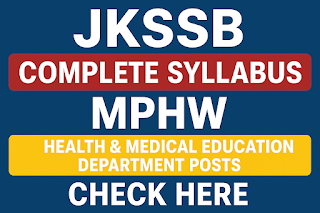
The Jammu and Kashmir Services Selection Board (JKSSB), a prominent exam conducting organization responsible for recruiting officials in the government of Jammu and Kashmir, has officially announced a job opening for the filling of the vacant posts of Female MPHW/ Male MPHW posts in the Health and Medical Education Department of Jammu and Kashmir for the year 2025. This examination checks the complete mental understanding of the candidate, as these posts are advertised in the Health sector, which demands zero negligence. The syllabus for these posts covers a vast domain of subjects, including theoretical knowledge and practical skills applicable in various health-related sectors of the department. The syllabus as prescribed by the Jammu and Kashmir Services Selection Board for the posts of Female MPHW/Male MPHW is divided into a number of sections, which cover Science, Nursing, Community Health, Sociology, Anatomy, Physiology, Microbiology, Psychology, Hygiene, and Nutrition.
Science-I: 20 Marks
This section will check the understanding of the candidates by asking questions from domains such as Anatomy, Microbiology, Psychology, Sociology, Physiology, Hygiene, and Nutrition. Candidates need to have an in-depth knowledge of these topics to be secured in the final list. Candidates should have a clear understanding of topics like human body structure and the functions of various parts of it, and also the relationship between health and other social factors. A total of 20 questions carrying 1 mark each will be asked from this section.
Fundamentals of Nursing-I (20 Marks)
This includes two sections, viz Section A and Section B. Section A covers topics including introduction to Nursing and other Nursing procedures, while Section B will mainly be focused on Nursing techniques such as personal care, hygiene, and basic patient needs and support, and Section C deals with topics such as First Aid and emergency nursing procedures.
Fundamentals of Nursing-II (20 Marks)
This section is also divided into three parts, viz Section A, Section B, and Section C. Section A will check the knowledge of the candidate based on topics such as Child Health, while Section B covers Maternal Health, and Section C introduces Family and Community Health. The overview of this section includes preventive care, maternal and child health monitoring, and basic health education.
Community Health Nursing-I (20 Marks)
Like the above two sections, this section is also subdivided into three further sections. Section A mainly emphasizes Domiciliary Midwifery, which includes antenatal care, home deliveries, and postnatal follow-ups, and more, while Section B introduces Midwifery and labor, Maternity Nursing, covering fetal development, pregnancy, complications, and obstetric operations. Section C mainly involves dealing with topics such as Family Planning and Welfare programs.
Community Health Nursing-II (20 Marks)
This section mainly tests the knowledge from the topics such as Nutrition Education, Health Education, and Communication Skills with Audio-Visual Aids. Candidates who are preparing for the exam need to learn all the essential methods to educate communities about nutrition, hygiene, and preventive health.
Community Health Nursing-III (20 Marks)
This section is further subdivided into four more sections, viz Section A, Section B, Section C, and Section D. Section A covers topics including Basic Medicine and Pharmacology, while Section B emphasizes Health Problems and Plans, and Section C deals with Communicable Diseases, including symptoms, prevention, and treatment. Section D mainly focuses on Mental Health, early detection of disorders, and available resources.
Anatomy & Physiology
Candidates preparing for the exam need to study topics that include skeletal and muscular systems, digestive system, urinary system, endocrine system, heart, respiratory system, and reproductive system. Complete understanding of the topics of cell structure, tissues, body organization, and metabolic processes is also a must.
Microbiology, Sociology, and Psychology
Candidates who are preparing for this examination need to study the classification of microorganisms, infection control, social structures, group dynamics, human behavior, life stages, emotions, defense mechanisms, and learning.
Hygiene & Nutrition
The hygiene and nutrition section mainly emphasizes the physical, mental, and environmental hygiene, health habits, and the preparation of balanced diets. Nutrition topics cover food classification, caloric requirements, nutrients, cooking methods, preservation, and malnutrition management.
Nursing Procedures and Techniques
The main objective of this section is to focus on topics including patient care, maternal health, family health, and community health. Focus is placed on maintaining medical records, organizing care, first aid, and emergency procedures.
Community Health Nursing
This section includes topics such as Domiciliary midwifery, maternal and child health, health education, environmental sanitation, communicable diseases, family planning, and nutrition education are central.